The department made a nice video and Adria is in it! Look for the ants and Adria around 1:20!
The lab is growing! We welcome Amritansh Vats, a PhD student, and Nicole Andreoli, a Masters student, to the social fluids lab. Amritansh comes to social insects from physics and he will focus on the social control of larval development. Nicole will focus on ant gustatory perception of trophallactic fluid components.

Welcome to PhD student Amritansh Vats!

Welcome to Masters student Nicole Andreoli!
Working with ants is wonderful in many ways but there is one interesting drawback/advantage: you can’t breed most species in the lab. Instead we need to go out and collect newly-mated queens just after they do their mating flights. Ant mating flights are rare events! They typically happen only one or a few days per year in the summer, so we need to be ready to quickly spring into action. These mating flights are also very linked to local temperature and humidity conditions, so the date of the flight varies from year to year and for a given year, from neighborhood to neighborhood. Then, even further, whether you’ll find the species you are looking for depends on the local population: are they enough mature colonies?
Considering we just set up shop in Fribourg, we didn’t know where/when the local ants would be flying, but we knew we wanted to collect some Lasius niger when they flew in Fribourg.
Well, yesterday was the day! The Lasius niger were flying just outside the door of the lab. It doesn’t get any more convenient than that! We had a guest visiting who went outside for a think and he popped his head in, “Is this a queen of the species you are looking for?” Yep! And as Marie-Pierre was putting the queen into a tube, he came back again, “I think I found another one…” And before you know it, we have 100+ queens ready to start their colonies.
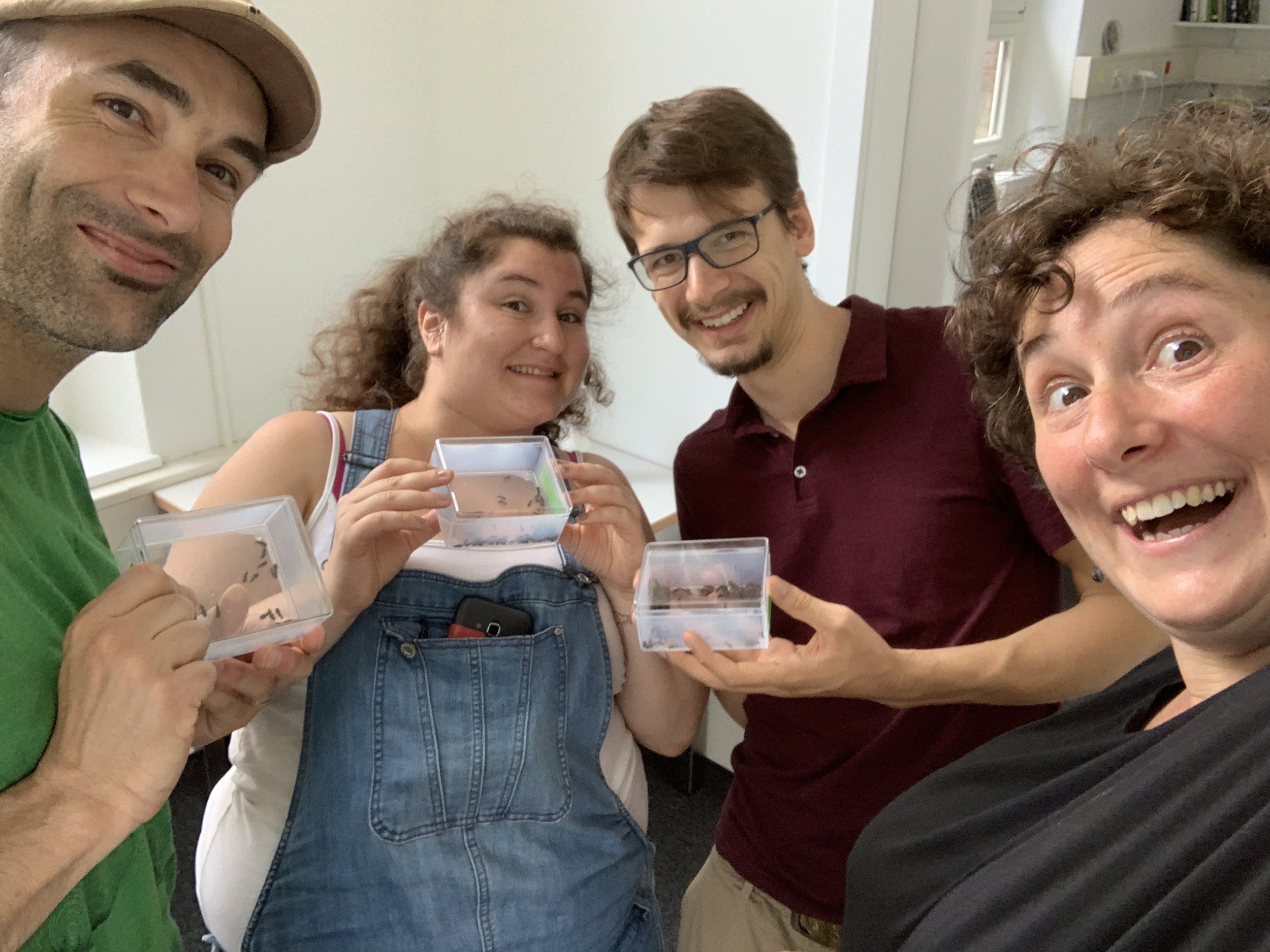
The lab is getting started! We’ve moved into our new space and the first founding queens I brought to the lab are finally getting their first workers. We do have other more mature colonies, but these are special – the foundresses.
Otherwise, the comparative adventure of trophallactic fluid is beginning. Marie-Pierre has been contacting labs around the world to set up this exciting project to explore the evolution of this social fluid and the social circulatory system.


Things are moving and changing: Today was the first day of the Laboratory of Social Fluids aka the LeBoeuf Lab!
Our lab is still being renovated so we are staying in temporary offices for the time being. We are going through all of the typical things that happen when you start somewhere new…getting connected to networks, printers, getting to know new colleagues, etc…

Speaking of new colleagues, the lab welcomes new PhD student Marie-Pierre Meurville! Marie-Pierre comes to us from Christoph Dessimoz’ group in Lausanne and she’ll be studying the evolution of trophallactic fluid.

It is thanks to the Swiss National Science Foundation’s PRIMA grant to Dr. LeBoeuf that the Laboratory of Social Fluids exists.
On April 3rd there was a grand kick-off event for the PRIMA grant in Bern where PRIMA grantees got to meet each other and talk about the importance and complications of being women in science.
If you scroll down the page you can even find a photo of Adria asking an awkwardly pointed question to Matthias Egger (he answered with aplomb of course).
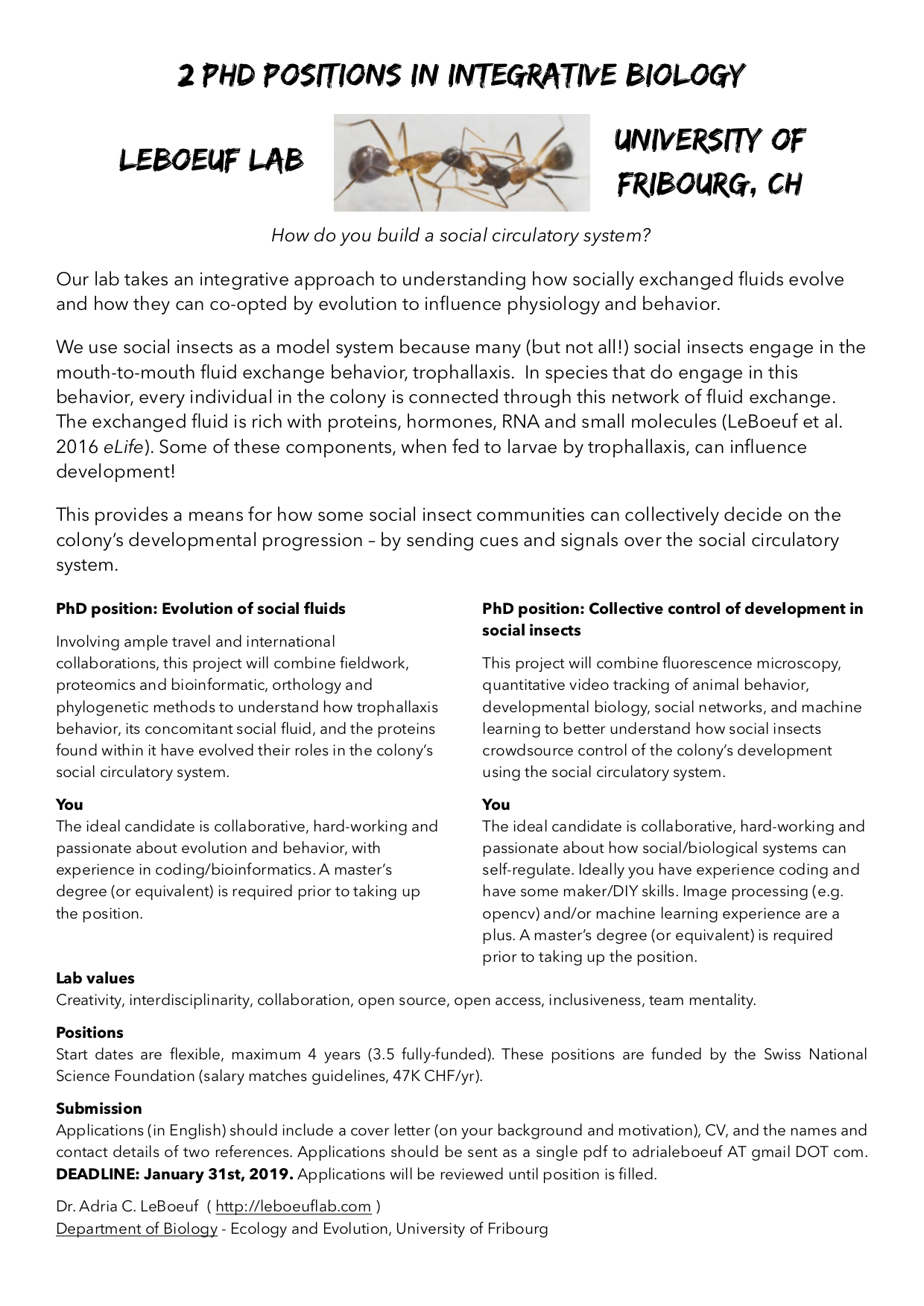
Please check out the PhD positions here!
Thrilled to say that our story about JHE evolution in Camponotus is out and available for your enjoyment!
Molecular evolution of juvenile hormone esterase-like proteins in a socially exchanged fluid