Research culture
I'm the Research Culture Champion for the Department of Zoology at the University of Cambridge. Below are some activities I run, and the framework I use to design them. If you’d like to try something at home, write to me and tell me how it went!
Philosophy: Creativity, Play and Casual Convening
Research culture is usually discussed as a list of problems: precarity, power imbalances, burnout, perverse incentives. Those problems are real, and many should be addressed by policy changes. But culture doesn't change through policy alone. It changes when people meet, talk honestly and try things together. So most of what I do is build the conditions for that.
Casual convening. The most useful conversations in science often happen by accident: in a corridor, over tea, or while waiting for a seminar to start. Casual convening means creating those accidents on purpose. I make low-stakes, low-effort spaces where people who wouldn't otherwise meet end up talking about things worth talking about. Nobody needs to prepare, nobody needs to be invited, and it's fine to just listen.
Play. Before I ran a lab, I spent ten years leading The Catalyst, a science-entertainment collective that uses improvisation to help researchers learn science storytelling, deal with failure and create fun content about science. Improv taught me that people take risks, say what they really think and connect fastest when the stakes feel low and things are a little bit fun. A dash of whimsy is not a distraction from serious conversations. Often it is what makes them possible.
Creativity. Academia mostly rewards people with papers, grants and titles, but there is another reward that is easy to forget: the chance to make something of your own. People do their best and most generous work when they are building something they care about, that they own. So I try to give people the freedom and the right, to do that: a student who wants to start a reading group, a postdoc with an idea for a new experiment, a technician who sees a better way to run things.
Write it down. Unwritten rules disadvantage the people least able to ask about them. Where I can, I turn implicit expectations into explicit, shareable documents, starting with my own lab's handbook.
“Creativity is a currency of reward.”
— Adria LeBoeuf
1. Culturing Research Culture lunches
An open lunchtime discussion series for everyone in the Department and beyond: undergraduates, postgraduates, postdocs, PIs, technicians and professional services staff. Each session takes one topic that matters to how we do science. See the detailed topics from 2025 and 2026
Past topics
2025: Parachute science · Power dynamics between PIs, postdocs and students · Rewiring incentives · Safety culture · Choosing a host lab · Beyond impact factors · What gets funded and published
2026: AI in research (two sessions) · Research culture in the field · Open data and code · Parenthood and caregiving · Neurodiversity in science · Mentoring each other · Gardening your CV
What came out of them. The fieldwork session produced two proposals: a departmental guide to avoiding parachute science, and a checklist of questions to settle with partners before fieldwork begins, which the session's participants are now developing.
Try it at home
Pick one topic per session and announce it.
Make it open to everyone, at every career stage. The mix is the point.
Tell people to bring lunch (or provide it).
Start with introductions and a short prompt or a couple of questions, not a talk.
At end ask: "Is there one thing we could actually do about this?"

2. Meet Your Neighbours Lab Tours
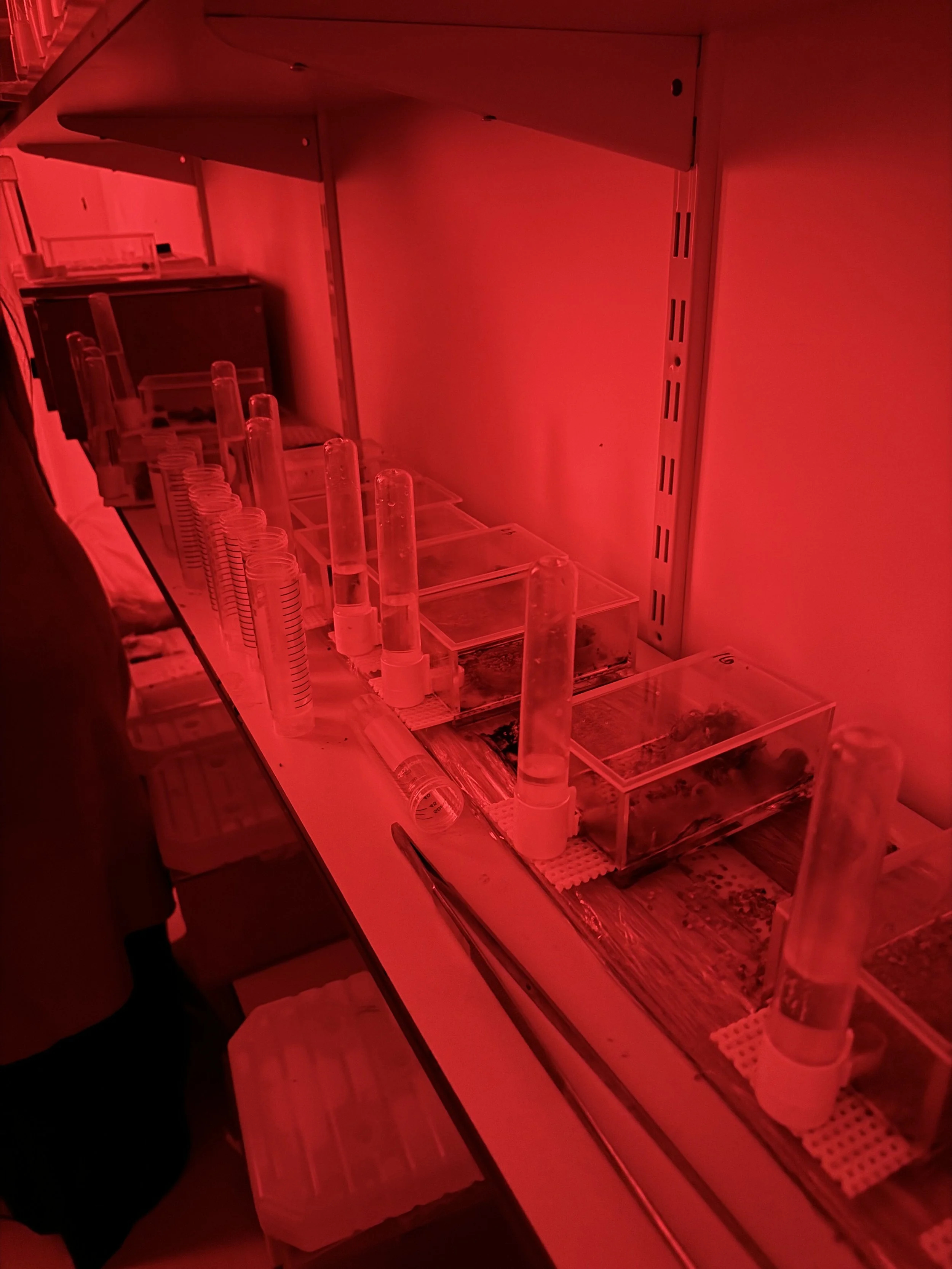
Lab tours where one research group opens its doors to the rest of the Department. Many groups share a building for years without knowing what happens two doors down. Meet Your Neighbour fixes that with very little effort: the host lab shows its space, its organisms and its questions, and visitors ask questions and meet people.
Try it at home
Invite all labs to sign up and choose their own date/time/
Keep it short and informal: ~45 minutes, no slides.
Have several lab members each host a "station", so everyone talks to someone.
Show something alive, moving or surprising. (Ants help.)
Have tea/coffee and chatting afterwards!
3. Lab Handbook Co-working Sessions
A lab handbook writes down everything a new group member would otherwise have to guess. Ours covers how I manage the group, how we share and credit data and materials, how authorship is decided, feedback deadlines that apply in both directions, how we look after ourselves and each other, and how to arrive, settle in and leave well.
I run co-working sessions where PIs write their own handbooks.
Try it at home
You don't have to start from scratch: adapt someone else's handbook. There are many online!
Block out a co-working session. It's much easier to write alongside others than alone. You can exchange tips and hour stories to inspire your writing.
Ask your group what they wish they had been told when they joined.
Treat it as a living document and revisit it every year.